

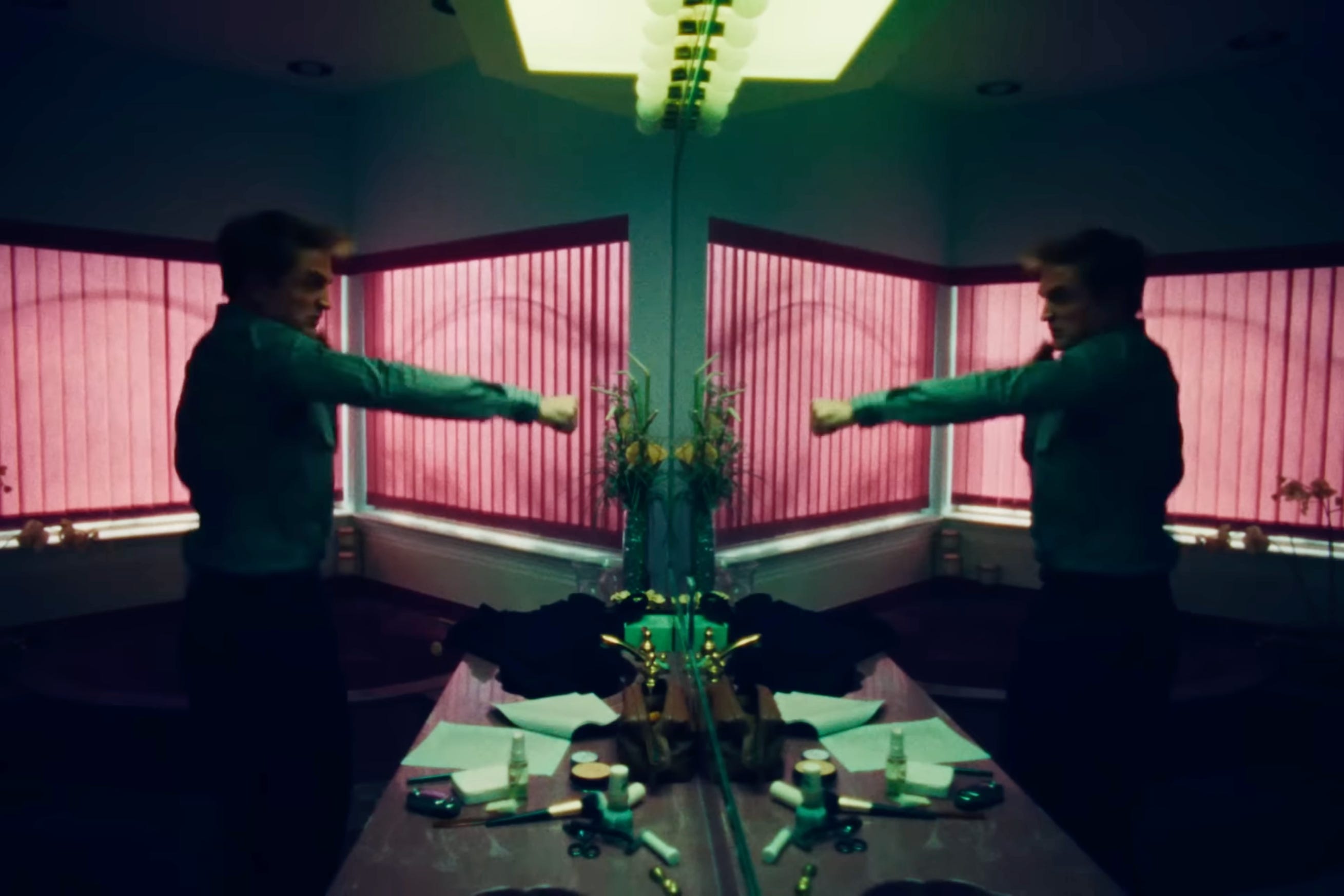
This week, I was able to see the west coast premiere of Robert Pattinson’s new film Primetime in Los Angeles. I found the movie an electrifying experience; it is inspired by true events, revolving around the 2000s NBC show To Catch a Predator, but plays the material in such an operatically heightened register that you could hardly mistake it for an attempt to recreate “what actually happened” with any degree of precision. Instead, it feels more like an effort to capture a nightmare you might have if you fell asleep in front of the television with the images and emotional tones of To Catch a Predator swirling around in your subconscious. Pattinson is ostensibly playing the show’s real-life host Chris Hansen, but he is not really trying to mimic Hansen the way you usually see with actors playing real people (say, Austin Butler as Elvis); instead, he is exaggerating Hansen into a bizarre, larger-than-life enigma. (At the Q&A following the screening, director Lance Oppenheim talked about how he imagined Hansen as a “mythological being,” and how he thought Pattinson was channeling Dracula to play him.) I love this sentence from Matt Zoller Seitz’s review: “[Primetime] bears roughly the same relationship to its real-world inspiration as the story of Amleth does to Hamlet.”
The film does indeed play like a quasi-Shakespearean tragedy, but as it unfolded, a different literary reference point kept coming to my mind: Herman Melville’s great American novel Moby-Dick; or, The Whale.
In Primetime, Hansen and his collaborators “fish” for would-be predators through online chat rooms, trying to lure them to homes where they expect to meet minors for sex but will instead be humiliated and arrested on camera. As the film progresses, Hansen – partly because he is being pressured by executives to compete with other networks, and partly because of his own overweening ego – becomes obsessed with catching a high-profile target to boost the show’s ratings. The nickname that Hansen and crew bestow on this fabled target?
“The whale.”
Moby-Dick, of course, is the story of the insane Captain Ahab’s obsession with chasing and destroying the white sperm whale Moby-Dick, who took his leg in a previous encounter. It is the quintessential example in American art of the narrative of the doomed quest, with a character consumed by his fixation on an unachievable goal that comes to take on existential importance. In Moby-Dick, the whale is, at least in Ahab’s mind, more than just a whale:
“All that most maddens and torments; all that stirs up the lees of things; all truth with malice in it; all that cracks the sinews and cakes the brain; all the subtle demonisms of life and thought; all evil, to crazy Ahab, were visibly personified, and made practically assailable in Moby Dick.”
As I mulled over Primetime and Chris Hansen’s obsessive quest for his own “whale,” my mind went to this passage almost immediately. Somewhere in the middle of the film, Hansen tells young actor Dan Plum (Skyler Gisondo) about an experience he had in India, where he was told that an evil spirit (visualized in the film by a ceremonial mask) was responsible for the disappearances of children from local villages. Hansen then tells Plum that through their work on To Catch a Predator, they are “cleansing the world of an ancient evil.”
It is a jarring scene that plays almost like a non sequitur, except that the mask symbolizing the evil spirit keeps appearing in the film – sometimes superimposed onto the face of Hansen’s “whale.” Thus, the Moby-Dick inspiration clicks into focus: for Hansen, as for Ahab, the whale is not just a whale but a visible personification of evil itself.
At this point, it hardly seems a spoiler to say that neither Ahab nor Hansen find the satisfaction they are seeking at the end of their monomaniacal quests. Indeed, I came away from Primetime thinking that Hansen himself had been spiritually hollowed out by the very evil he was so determined to root out and destroy, and that the image of him shadowboxing himself in the mirror could almost function as a key to the entire film.
Just from watching the movie, it seemed almost certain to me that screenwriter Ajon Singh had Moby-Dick on the brain, but another piece of evidence cropped up, rather humorously, during the post-screening Q&A. Discussing one hilariously bizarre moment where Pattinson-as-Hansen spits mouthwash into his hotel room sink, Oppenheim mentioned that Pattinson had improvised the motion – whereas the script had specified that Hansen should blow the mouthwash “like a sperm whale.”