
The Guardians Strike Back

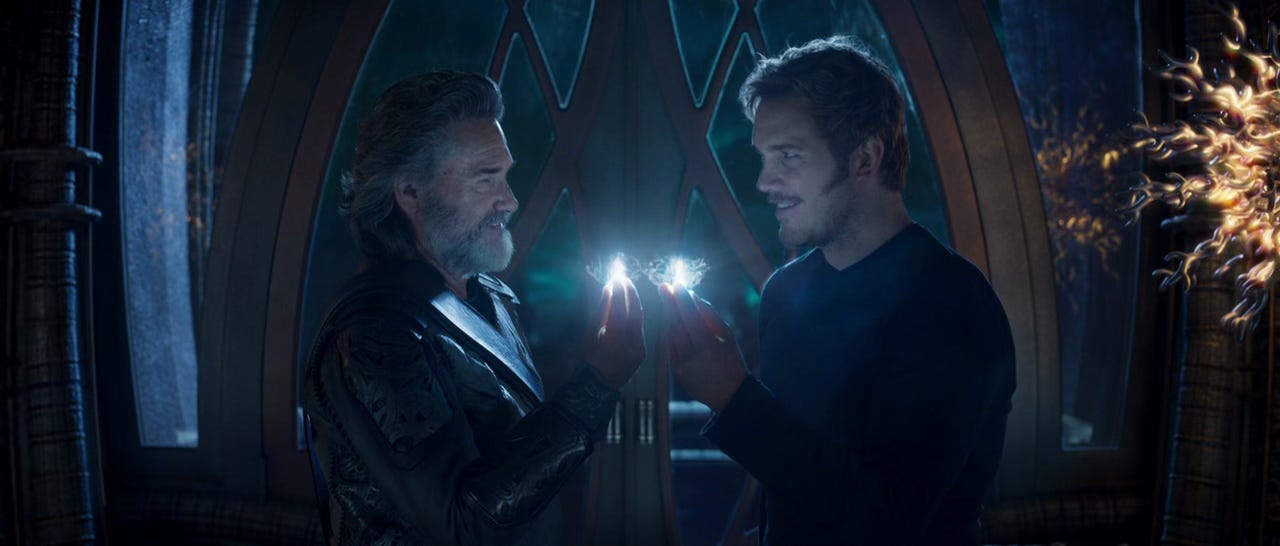
This week, I rewatched Guardians of the Galaxy Vol. 2 to prep for a FilmFisher essay (which will be published this coming Tuesday). My relationship with the film is a funny one: I had a visceral reaction against it when I saw it on opening night with a group of college friends in 2017, but my opinion has steadily reversed over the years, to the point that I might now name it the best movie in the Marvel Cinematic Universe.
Before the film came out, I think I assumed on some level that it would riff on The Empire Strikes Back. It seemed obvious: people had been calling the original Guardians of the Galaxy “the Star Wars of its generation” (a laughable claim, but this is not the space to litigate that) and the sequel promised to involve revelations about Peter Quill’s mysterious father. Then I saw it: Peter’s dad turned out to be an archvillain, and unlike Luke Skywalker, Peter killed him instead of forgiving and redeeming him. Bingo! This seemed fairly straightforward, so I clocked it and then moved on.
On this viewing, however, it hit me that Vol. 2 is a far more thorough and meaningful subversion of The Empire Strikes Back than I had given it credit for.1
In marked contrast to Darth Vader (“dark father”), Peter’s tyrannical father Ego is associated with light. In the first Guardians of the Galaxy, Ego is described by Peter’s mother as “an angel made out of pure light,” and this turns out to be more or less literally the case: he draws his power from “the light” within his planet, which is to say from the glowing celestial brain that is his true form. It is fitting that the phrase “an angel of light” recalls St. Paul’s description of Satan in 2 Corinthians 11:14: Ego postures as a god, but is really a devil, and even more of a monster than Darth Vader. Vader turns out to have a sincere love for his son beneath his frightening exterior; Ego presents himself as a loving father, but turns out to have no genuine care for anyone other than himself.
Ego is not only a twist on Darth Vader, though: he is also a twist on Yoda! In the second act of Empire, Luke travels to the old Jedi Master’s planet to be trained how to use the Force; in the second act of Vol. 2, Peter travels to Ego’s planet, where his father teaches him how to use his own supernatural powers. In Empire, Yoda counsels Luke to cultivate an attitude of Gnostic detachment from the physical world and from his friends. “Luminous beings are we, not this crude matter,” Yoda tells his pupil – a sentiment that could also be applied with remarkable aptness to Ego, who creates a material form for himself but is actually made out of light. When Luke wants to leave his training to rescue his endangered friends, Yoda urges him to let them go in the name of the greater good. Likewise, when Peter perceives a conflict between his friendships and Ego’s ambitions, his father urges him to let them go in the name of the higher “purpose” he has in mind.
There are numerous other structural and plot parallels (an early escape through an asteroid field from a collective of officious Brits, who, after losing the heroes, hire bounty hunters to find them; a crash landing on a green planet; a descent into a cave that reveals the father’s true nature; a separation of the heroes into separate subplots before they reconvene for the climax), but the influence of The Empire Strikes Back is so ubiquitous that these sorts of nods are simply to be expected in the second entry of a blockbuster trilogy (see also: The Matrix Reloaded, Pirates of the Caribbean: Dead Man’s Chest). What I find really compelling is that Guardians of the Galaxy Vol. 2 is not merely tipping its hat to the definitive space opera sequel, but opening a dialogue with its core themes and putting its own distinct twist on them. A critique of the Jedi’s ethos of disembodied detachment is ultimately central to the Star Wars saga, but by making Ego the villain and painting him in such stark terms, Guardians of the Galaxy Vol. 2 blasts this way of thinking with a vicious directness that Star Wars (in which the Jedi are always framed as the “good guys,” whatever their failings) never does.
It is a wild coincidence that 2017 saw the release of not one but two “middle movies” directly responding to The Empire Strikes Back. The other one, of course, was an actual Star Wars episode: The Last Jedi.