

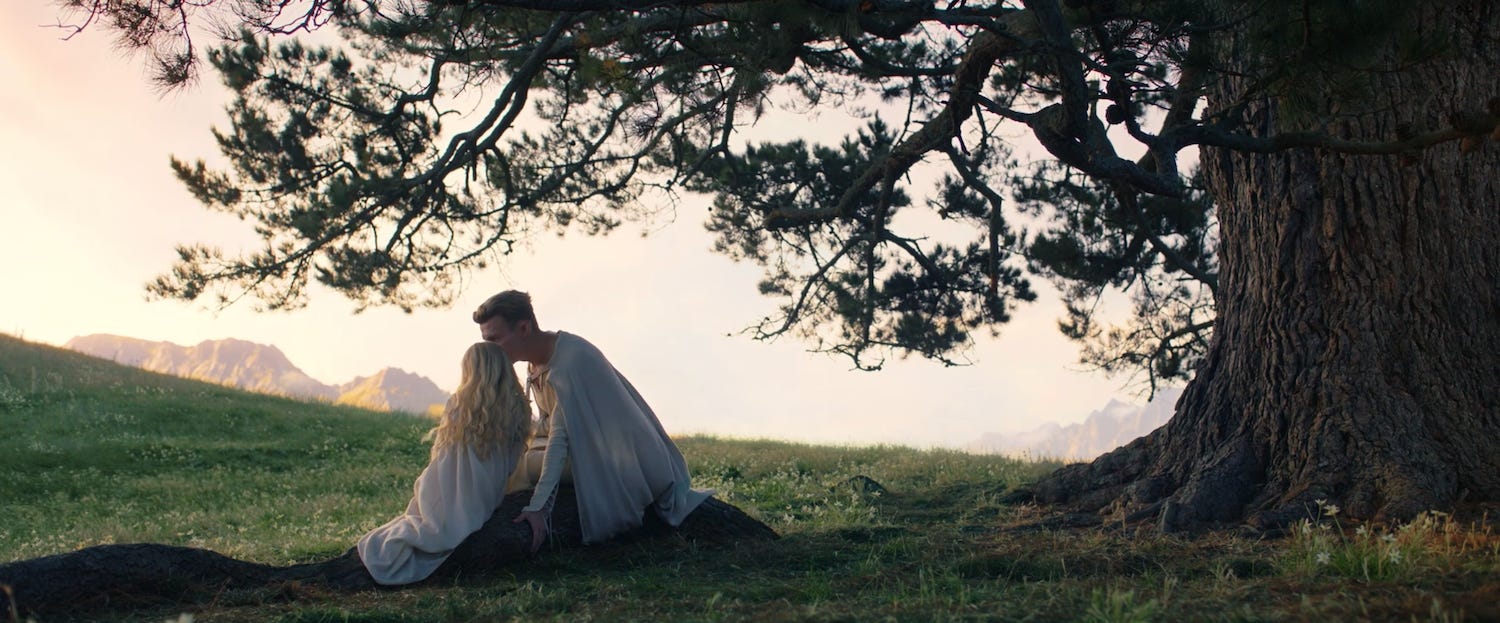
Nothing is evil in the beginning.
So begins The Rings of Power, Amazon’s ambitious prequel to The Lord of the Rings. Before its premiere, many Christian commentators expressed concern that the series would reject, subvert, or otherwise compromise the Catholic underpinnings of J.R.R. Tolkien’s work, but such fears should have been soothed by an opening statement so deeply in tune with Tolkien’s Christian cosmology. In Tolkien’s world, good is the fundamental, primary reality, while evil is merely a corruption, a cancer. “Nothing is evil in the beginning” because the cosmos was created good by a good Creator. Evil is not a positive presence, but an absence of good, as darkness is an absence of light. In the words of Tolkien’s fellow Inkling, C.S. Lewis, “Goodness is, so to speak, itself: badness is only spoiled goodness.” Or, as Tolkien himself puts it in the poem “Mythopoeia”:
…evil lies
not in God’s picture but in crooked eyes,
not in the source but in malicious choice,
and not in sound but in the tuneless voice.
“Nothing is evil in the beginning” is a profound consolation, then, for it means that evil is cosmically outmatched by good. Evil cannot prevail over good in a final sense because evil owes its very existence to good; in the end, the conflict between good and evil is not a war between equal and independent powers so much as a rebellion of the branch against the tree. There was a time before evil existed, and there may be a time after evil has passed away, but there never was, never will be, and never can be a time without good. This is the consolation that the human healer Bronwyn (Nazanin Boniadi), quoting Tolkien almost verbatim, extends to her son Theo (Tyroe Muhafidin) late in The Rings of Power’s first season: “In the end, this shadow is but a small and passing thing. There is light and high beauty forever beyond its reach.”
Bronwyn’s comforting speech to Theo recalls another speech about light and darkness from the opening passages of the series. In Valinor, the deathless home of the Elves, the young Galadriel (played as an adult by Morfydd Clark) creates a beautiful model of a ship, only to see it sink under stones thrown by rivalrous children. Her elder brother, Finrod (Will Fletcher), comforts her with the following words:
Do you know why a ship floats and a stone cannot? Because the stone sees only downward. The darkness of the water is vast and irresistible. The ship feels the darkness as well, striving moment by moment to master her and pull her under. But the ship has a secret, for unlike the stone, her gaze is not downward but up, fixed upon the light that guides her, whispering of grander things than darkness ever knew.
Like Bronwyn, Finrod consoles his young charge by affirming the ascendancy of good over evil, of light over darkness. For Bronwyn, light is forever beyond the grasp of darkness; for Finrod, darkness is baffled by even a whisper of light. As in the beginning of St. John’s Gospel, “the light shines in the darkness, and the darkness did not comprehend it.” However, in response to Finrod’s speech, Galadriel poses a dilemma:
Sometimes the lights shine just as brightly reflected in the water as they do in the sky. It’s hard to say which way is up and which way is down. How am I to know which lights to follow?
Galadriel’s perplexity, no less than Finrod’s consolation, is rooted in the truth that “Nothing is evil in the beginning.” If nothing is evil in the beginning, where does evil have its origin? The answer is in the image of the reflections: evil is not original. Just as the false reflection is derived from the true light, evil is a spurious distortion of good. Sauron, like Satan, was once an angel of light; the orcs were once elves. There is comfort to be found in the fact that evil has no independent existence of its own, but as Galadriel rightly points out, the derivation of evil from good can lead to a dangerous confusion.
Thus, the statement “Nothing is evil in the beginning” can be both a consolation and a caution. In The Rings of Power, spoken by Galadriel over images of Valinor’s golden light, it is an evocation of Edenic bliss. In The Fellowship of the Ring, spoken by Elrond at the council of Rivendell, it is a sobering warning to any who would try to reach noble goals by dubious roads:
If any of the Wise should with this Ring overthrow the Lord of Mordor, using his own arts, he would then set himself on Sauron’s throne, and yet another Dark Lord would appear… For nothing is evil in the beginning. Even Sauron was not so.
In this context, “Nothing is evil in the beginning” is not a stirring affirmation of the primacy of good. Instead, it leaves us with a discomfiting reflection: if all evil things were originally good, how can we be sure that our good intentions will not lead us down an evil path? In Lewis’ words, “Wickedness, when you examine it, turns out to be the pursuit of some good in the wrong way.” In the language of Galadriel’s dialogue with Finrod, evil arises when a reflection of light is followed away from the source of light – when some earthly end, good in itself, is made the ultimate end and thus believed to justify evil means.
At the beginning of The Rings of Power, Galadriel stands upon just such a knife’s edge between light and darkness. Her goal seems good, but the quest to achieve it may yet drive her to evil, for nothing is evil in the beginning.