
Wake Up Dead Man
New Review at FilmFisher

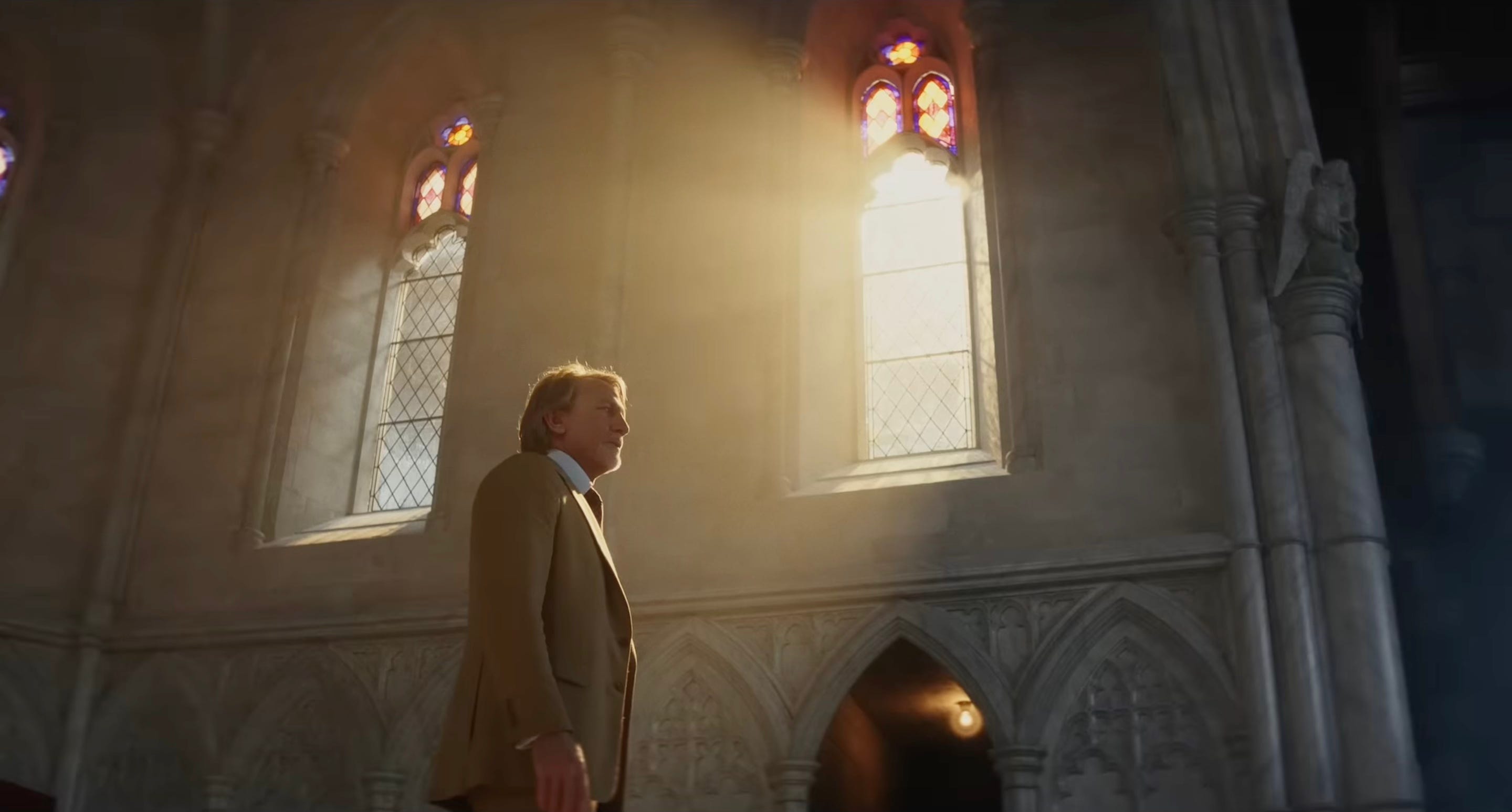
Late one night in 1931, J.R.R. Tolkien and C.S. Lewis had a conversation that went on to become the stuff of legend in Christian culture. The then-unconverted Lewis could not understand how Jesus Christ’s death and resurrection were supposed to have any real effect on modern men living 2,000 years later; the Catholic Tolkien, appealing to his friend’s wide-ranging scholarship in world mythology, pointed out that Lewis’ heart was mysteriously stirred when he encountered pagan myths about gods who died and rose again and, in their rising, somehow granted new life to their followers. Shortly thereafter, on the cusp of his conversion to Christian faith, Lewis wrote, “in Pagan stories I was prepared to feel the myth as profound and suggestive of meanings beyond my grasp even tho’ I could not say in cold prose ‘what it meant’... Now the story of Christ is simply a true myth: a myth working on us in the same way as the others, but with this tremendous difference that it really happened, and one must be content to accept it in the same way.” Tolkien later dedicated his poem “Mythopoeia” to Lewis: “To one who said that myths were lies and therefore worthless, even though ‘breathed through silver’.”
It would not surprise me to learn that writer-director Rian Johnson – who was raised Christian and is no stranger to the Inklings, having drawn from Lewis’ Perelandra and Tolkien’s The Two Towers for his Star Wars film The Last Jedi – had this conversation in mind when approaching the first dialogue between Catholic priest Jud Duplenticy (Josh O’Connor) and skeptical detective Benoit Blanc (Daniel Craig), the two heroes of Wake Up Dead Man. Fr. Jud is a suspect in the murder of his church’s Monsignor, and Blanc is on the scene to investigate the seemingly impossible crime; but before Blanc reveals his purpose, he engages Jud simply as a curious, if rather hostile, visitor to the church. A “proud heretic” who wants to puncture the Church’s “perfidious bubble of belief,” Blanc derisively describes the Gospel as a “child’s fairy tale” and Christian worship as “storytelling.” Jud’s response has something of Tolkien in it: “You’re right. It’s storytelling. The rites and the rituals. Costumes, all of it. It’s storytelling. I guess the question is, do these stories convince us of a lie? Or do they resonate with something deep inside us that’s profoundly true, that we can’t express any other way except storytelling?”
The third in a series of standalone mystery movies starring Craig as Blanc that began with 2019’s Knives Out and continued with 2022’s Glass Onion, Wake Up Dead Man is arguably a tad less tightly-wound and sharply funny than its two predecessors, but it is the most richly moving and thought-provoking of the trio by a country mile because of Jud and Blanc’s ongoing dialogues about reason and faith, justice and grace. Apart from the behind-the-scenes crew (Johnson and his stable of collaborators) and the presence of Blanc, each of these films is a unique entity, with an entirely new cast of characters (or set of suspects) and a distinctive theme. In Wake Up Dead Man, that theme is Christianity. Knives Out took Blanc to an autumnal New England manor and Glass Onion took him to a sun-dappled private island; Wake Up Dead Man takes him to a Gothically gloomy Catholic church, where a clergyman has been killed in the nave, presumably by one of his parishioners, in a case provocatively referred to as “The Good Friday Murder.”
Knives Out and Glass Onion were broadly satirical takedowns of old money and new money, respectively, but Johnson approaches his chosen subcultural setting this time with more careful nuance and complexity. He cannot resist taking some clear potshots at contemporary American distortions of Christianity, which reduce the Church to one more anxious, reactive combatant in a culture war (”There’s G-O-D in DOGE,” reads the clickbait title of one YouTube video), but he does not condescend to Jud’s sincerely committed faith. The Christian theming sometimes borders on tongue-in-cheek kitsch, like a Christian rebranding of Clue; one character describes another as being “A few beads shy of a full rosary” and Jud calls himself “young, dumb, and full of Christ.” However, the Christian allusions are not just winking jokes, but hints pointing to the story’s underlying foundation in Christian typology and symbolism – because Wake Up Dead Man is, in fact, a retelling of the Christian “myth”.